Abstract
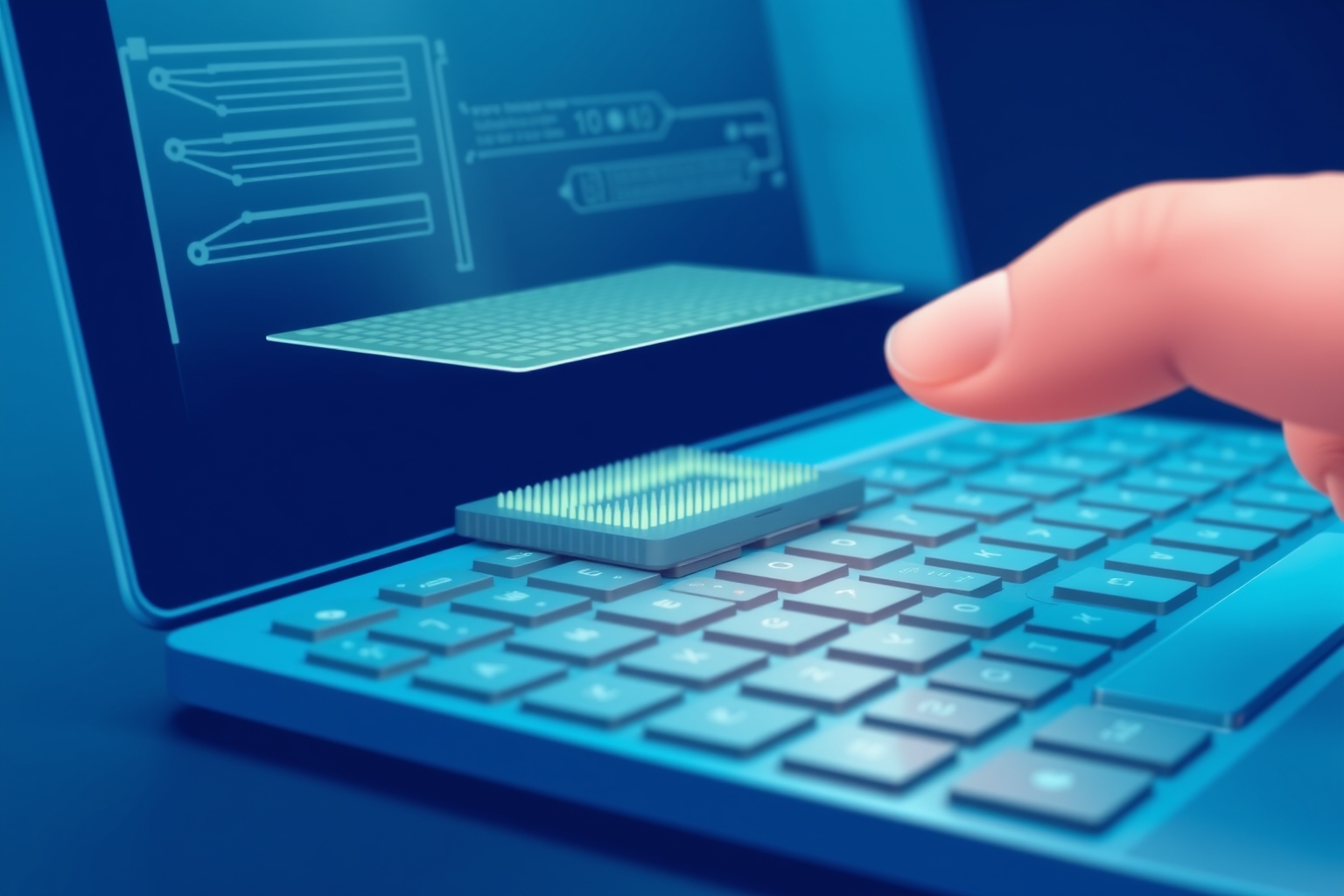
Standard touchscreen keyboards provide reactive haptic pulses: a short vibration fires after a key is registered, confirming that a tap was detected. Feedforward haptics invert this model by delivering tactile cues slightly before or during the gesture, shaping finger trajectory toward the target rather than acknowledging arrival. Research groups at ETH Zurich and Carnegie Mellon’s Human-Computer Interaction Institute have investigated whether actuator arrays embedded beneath OLED panels can reduce character error rate on soft keyboards without requiring users to consciously attend to the feedback. The evidence so far is encouraging for narrow use cases but complicated by actuator fidelity, latency budgets, and how much users trust a keyboard that seems to be guiding their hands.
How Feedforward Differs from Conventional Vibrotactile Confirmation
Reactive haptic feedback, the short buzz produced by most iOS and Android keyboards, operates on a simple confirm-and-release pattern. The signal carries no information about whether the key was the intended target; it only indicates that a registered touch crossed the activation threshold. Feedforward approaches use a different signal architecture. A predictive model tracks finger velocity and approach angle in real time and fires actuators in the key region toward which the finger is most likely heading, not the key it is directly above. The physical sensation functions as a mild draw, a texture or resistance gradient that the finger interprets subconsciously and that can shift final contact a few millimeters in the corrective direction.
Actuator hardware has historically been the bottleneck. Eccentric rotating mass motors cannot produce spatially localized output at millisecond precision. Linear resonant actuators improve spatial selectivity but still lack the resolution needed for per-key addressability across a standard keyboard layout. Piezoelectric arrays bonded to the touch layer are closer to viable: laboratory setups at ETH Zurich have demonstrated 8x12 grid actuation beneath a 6-inch display area, sufficient to cover most character keys with independent signals.
Error Rate and Throughput Data from Controlled Studies
A 2025 study conducted at CMU’s HCII compared three conditions - no haptics, reactive haptics, and feedforward haptics - across 40 participants typing standardized Mackenzie-Soukoreff phrase sets. Feedforward haptics reduced uncorrected character error rate by 18 percent relative to the no-haptics baseline, compared to 9 percent for reactive haptics. Typing speed in words per minute showed no statistically significant difference across conditions after a 20-minute adaptation period, suggesting feedforward feedback does not impose a throughput penalty once users habituate. Participants with smaller hand span benefited more, likely because key spacing relative to finger size amplifies the value of corrective guidance.
The same study found that feedforward haptics degraded performance when users were asked to type unfamiliar strings (random character sequences), where the predictive model’s prior over likely next characters was weak. This reveals a dependence on language model integration: the feedforward signal is only as good as the predictive layer feeding it.
System Architecture Constraints
Implementing feedforward haptics at commercial scale requires solving three engineering problems concurrently. First, prediction latency must stay below approximately 30 milliseconds from finger detection to actuator fire; longer delays push the feedback into the reactive regime and eliminate the guiding effect. Second, the language model informing predictions must run on-device to avoid network round-trip jitter, constraining model size to something achievable with an NPU budget of roughly 5 watts on a 2025-tier mobile SoC. Third, personalization is necessary because different users have substantially different error profiles and approach angles. A cold-start feedforward system performs worse than no haptics for roughly the first two sessions until user-specific calibration data accumulates.
Apple’s Taptic Engine architecture, as of current-generation iPhones, does not expose the actuator array at the granularity feedforward systems require. Custom hardware partnerships or mid-tier Android OEM collaborations are the more likely early deployment path. Researchers at Immersion Corporation have filed patents on actuator layouts compatible with this use case, suggesting commercial interest is present even if products are not yet shipping.
Open Questions
Feedforward haptics on touchscreen keyboards remain a laboratory-stage technology for most deployment contexts. The clearest near-term path is in accessibility, where users with motor impairments stand to gain disproportionately from corrective guidance and where the bar for specialized hardware is lower. Mainstream adoption depends on actuator cost trajectories, OEM willingness to expose low-level haptic APIs, and whether the user experience benefit survives the transition from controlled lab conditions to the noise and distraction of real typing contexts.